

Marketing
Webinar Recap | Scaling The Student Voice for Strategic Systemwide Impact
How the University of Hawaiʻi System and Nebraska State College System are turning student voice into measurable retention outcomes
In a recent webinar with the National Association of Higher Education Systems (NASH), two universities shared what it looks like when you finally start listening to students at scale. Read on to learn how the University of Hawai’i System and Nebraska State College System are using AI to capture and act on student voice data across their institutions.
The Problem With Lagging Indicators
When a student fails an exam, that failure enters your SIS. An early alert fires, an advisor reaches out with information about tutoring, and the student ignores it. What you didn’t know: that student has been working two jobs since their employer cut their hours six weeks ago. They’re sleep-deprived and struggling financially. Tutoring isn’t what they need.
This type of miss is playing out on higher education campuses every semester. It’s the direct result of building student success workflows on data that only tells you what happened — not why.
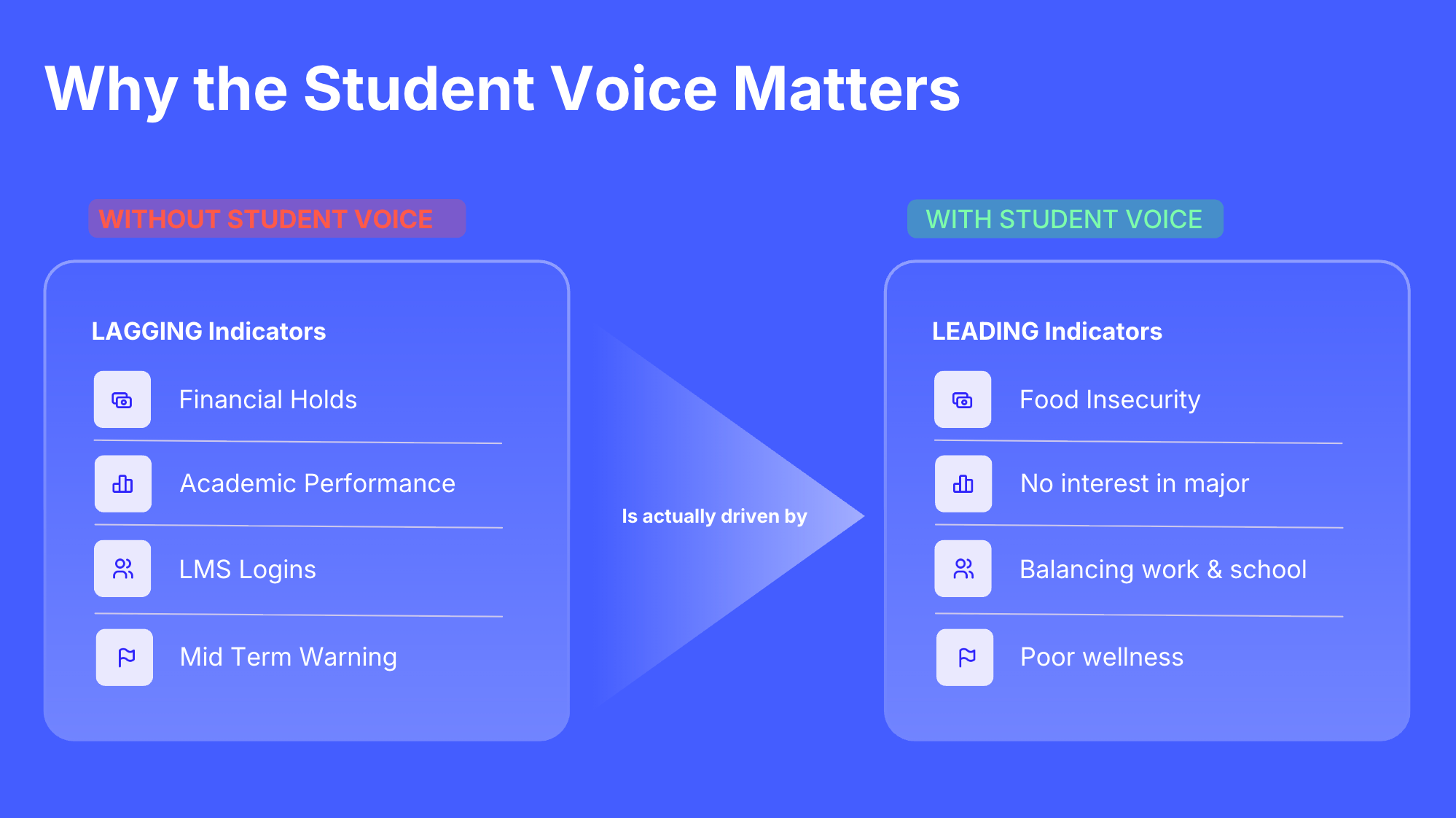
This is the difference between lagging and leading indicators. Lagging indicators — financial holds, missed payments, low attendance — are the traditional signals for flagging struggling students. The student voice, on the other hand, can surface what’s actually driving those behaviors: food or housing insecurity, poor wellness, lack of connection to campus, and lack of interest in their major. These are the real persistence barriers, and they rarely appear in your data until it’s too late to act.
The challenge, of course, is collecting that student voice from the entire student body in a way that is scalable and actionable. This is made even more challenging for higher education systems, where students may be experiencing different barriers and trends across each unique institution.
Enabling a consistent, scalable way to collect and act on student voice, though, as demonstrated by the two systems leaders from the webinar, can be transformative for student success.
University of Hawaiʻi System: One Platform, Ten Distinct Identities
The University of Hawaiʻi System operates across six islands, bringing together ten independently accredited institutions (three universities and seven community colleges) serving more than 51,000 students. Each campus supports a distinct student population, from traditional undergraduates to part-time learners balancing work and family. At several community colleges, part-time enrollment reaches 80%, with many students identifying as first-generation, Pell-eligible, adult learners, or working parents—each navigating a very different path through higher education.
The University of Hawaii at Mānoa launched with EdSights in August 2023. When Kim Siegenthaler, Senior Advisor to the President, arrived at the system shortly after, she saw immediately what a platform like EdSights could do — not just for one campus, but for all ten.
The goal was a cohesive, system-wide approach to student success: a common standard of care that every student, at every campus, could count on regardless of institutional size or staffing levels. EdSights made that vision operationally achievable. All ten campuses went live within six months, each with its own branded Student Voice AI identity rooted in campus culture, all feeding into a unified framework for proactive student support.
Engagement across the University of Hawaiʻi System:
- 94% Opt-In Rate
- 117,700+ Texts Received
- 52% Student Engagement Rate
The impact in the first semester:
- 7,501 automatic connections to UH resources — without any human staff involvement
- 4,258 student interactions flagged for staff follow-up
- 627+ staff hours saved
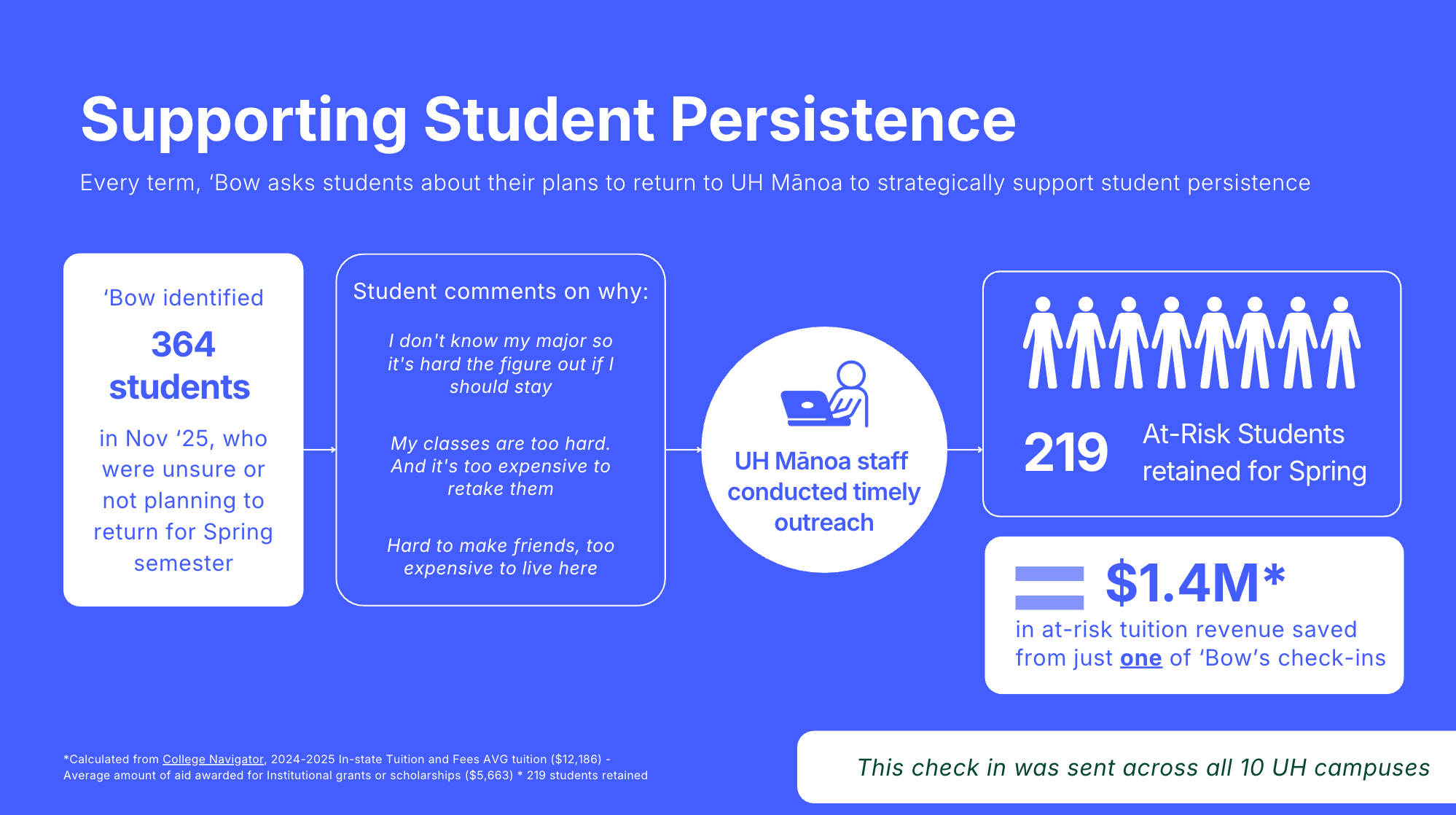
One touchpoint captures the value of this approach clearly. Every term, ʻBow asks UH Mānoa students about their plans to return the following semester. In November 2025, that single check-in identified 364 students who were unsure about returning for spring. Their reasons, in their own words:
"I don’t know my major so it’s hard to figure out if I should stay."
"Hard to make friends, too expensive to live here."
UH Mānoa staff conducted timely outreach. 219 of those 364 students were retained for spring, representing an estimated $1.4 million in at-risk tuition revenue saved from a single check-in. At Honolulu Community College, the same check-in identified 126 at-risk students; 39 were retained, protecting $66,000 in tuition revenue.
Nebraska State College System: Building a Culture of Connection
Nebraska State College System — Chadron State, Peru State, and Wayne State, serving approximately 8,500 students, had a clear goal: improve student success by meeting students where they are. Traditional email wasn’t cutting through; students preferred other modes of communication, and the system needed a more personalized, responsive way to keep them connected and on track academically, financially, and socially.
Cheri Polenske, Vice Chancellor for IT and CIO, helped launch all three institutions with EdSights simultaneously in January 2025 as a systemwide strategy to proactively identify and address student barriers in real time.
Engagement across NSCS:
- 94% Opt-In Rate
- 46,800+ Texts Received
- 65% Student Engagement Rate
While these engagement metrics are strong, the value of the tool is best understood through how it translates engagement into timely interventions that support persistence and completion.
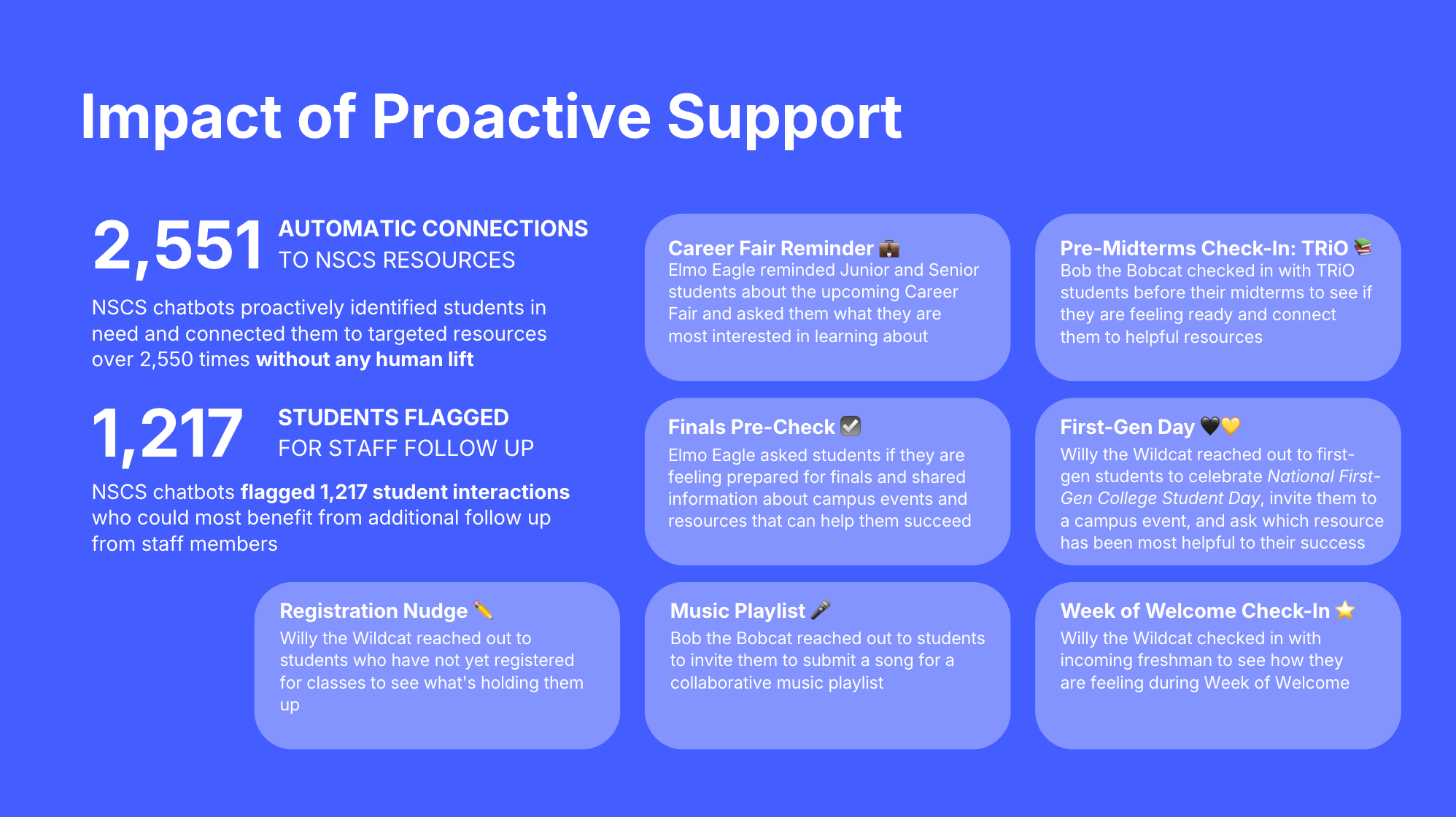
As Polenske shared, the campaigns themselves tell the story of what personalized student engagement actually looks like in practice: TRiO students were checked in with before midterms to identify academic support needs early. Juniors and seniors were nudged ahead of the career fair to strengthen career readiness and post-graduation outcomes. First-generation students were recognized on National First-Gen Day, reinforcing belonging and connection, which are key predictors of retention. One campus invited students to submit songs for a community playlist — and got one of their highest response rates of the year, demonstrating how low-barrier engagement can build trust and increase responsiveness to future success-oriented outreach.
The impact:
- 3,110+ student questions answered without staff involvement
- 250+ staff hours saved
- 1,217 students flagged for staff follow-up
In Fall 2025, the NSCS persistence check-in identified 181 students who were unsure about or not planning to return for spring. Their reasons:
"Financial issues."
"Dealing with 4 kids and work I don’t have a lot of time to do my schoolwork."
"Undeclared and I have no clue how to go about picking a major."
NSCS staff conducted timely outreach. 115 of those 181 students were retained — protecting approximately $1 million in at-risk tuition revenue from a single check-in. These weren’t students who would have shown up in a midterm warning or a financial hold. They were quietly deciding to leave. The only reason the institution knew was because they were asked.
The Takeaway
Every retained student matters — financially, institutionally, and for the individual whose life changes when they earn a degree. But the systems higher education has relied on for decades were built to track students, not listen to them.
What the University of Hawaii System and Nebraska State College System have demonstrated is that this is solvable — not by adding more staff or more surveys, but by adding the missing layer: continuous, direct, actionable Student Voice Intelligence.
Want to see what Student Voice Intelligence looks like at your institution? Click here to learn more.



Experience the Future of Student Success


