

Student Success at Scale: How Dallas College Re-Enrolled 366 Students Who Weren't Sure They'd Return

Student success can get harder to coordinate as an institution grows. At PERSIST 2026, our annual partner summit, three Dallas College leaders shared how they got seven campuses working from the same student data, starting with 15,000 first-year students.
Speakers:
- Dr. Pamela Luckett, Chief Digital Engagement Officer, Dallas College
- Dr. Karen Stills, Sr. Associate Vice Chancellor, Student Success, Dallas College
- Dr. Jason Kelley, Dean of First-Year Experience Programming, Dallas College
Dallas College became one accredited institution in 2020, when seven separate colleges merged. It now serves more than 130,000 credit and continuing education students, supported by 269 success coaches.
At that scale, Dallas College needed a clearer way for staff to prioritize their time and support students most in need. They partnered with EdSights to deploy conversational AI that proactively checks in with students, answers their questions, and flags students who would benefit from success coach follow-up.
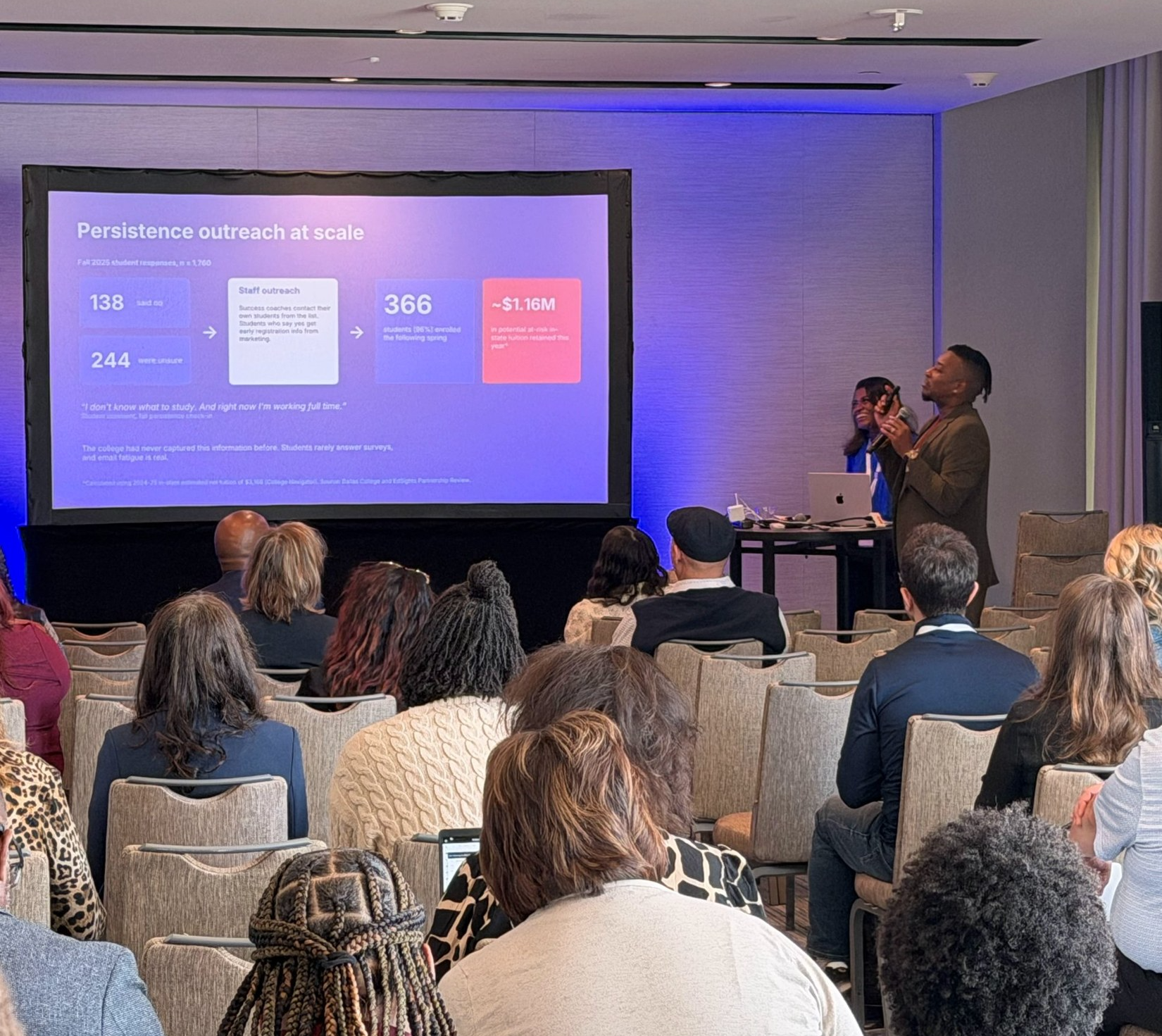
Through this system, in fall 2025, 382 students said they were not planning to return or were not sure. 366 of them enrolled the following spring, a 96% return rate that Dallas College estimates kept roughly $1.16M in tuition with the college.
A shared view of what students are saying
Dallas College kicked off their work with EdSights with 15,000 first-year undergraduates. The goals were to personalize first-year support, simplify systems across campuses, and improve first-year retention.
To act on what students shared with the AI mascot, the college deployed three workflows:
- Alerts for students who raise an urgent hand for help. Counseling, Title IX, student rights, and crisis teams all signed on to support these students within 24 hours of the alert being raised. Each type of alert also has a clear process map, built to last as staffing changes.
- Intervention lists for concerns that are not emergencies but are worth follow-up. Success coaches can clearly see which students would benefit from additional support, and why, with students and data organized by coach.
- Data deep dives, monthly and quarterly reviews of what students are saying to inform institutional strategy and priorities.
Asking students directly saved $1.16M in tuition revenue
Students rarely answer surveys, and email fatigue is real, so the college had never had access to this kind of student feedback and data at scale.
In a check-in about persistence in fall 2025, 138 students said they were not planning to return, and 244 said they were unsure. One student wrote, "I don't know what to study. And right now I'm working full time."
Success coaches contacted their own students from the list of 382 who said no or were unsure, and marketing sent early registration information to students who said yes. 366 of those 382 students enrolled the following spring, resulting in roughly $1.16M in-state net tuition saved. Without that early indication of intention to return, coaches would not have known which students needed the additional support.
Shaping institutional priorities with direct student feedback
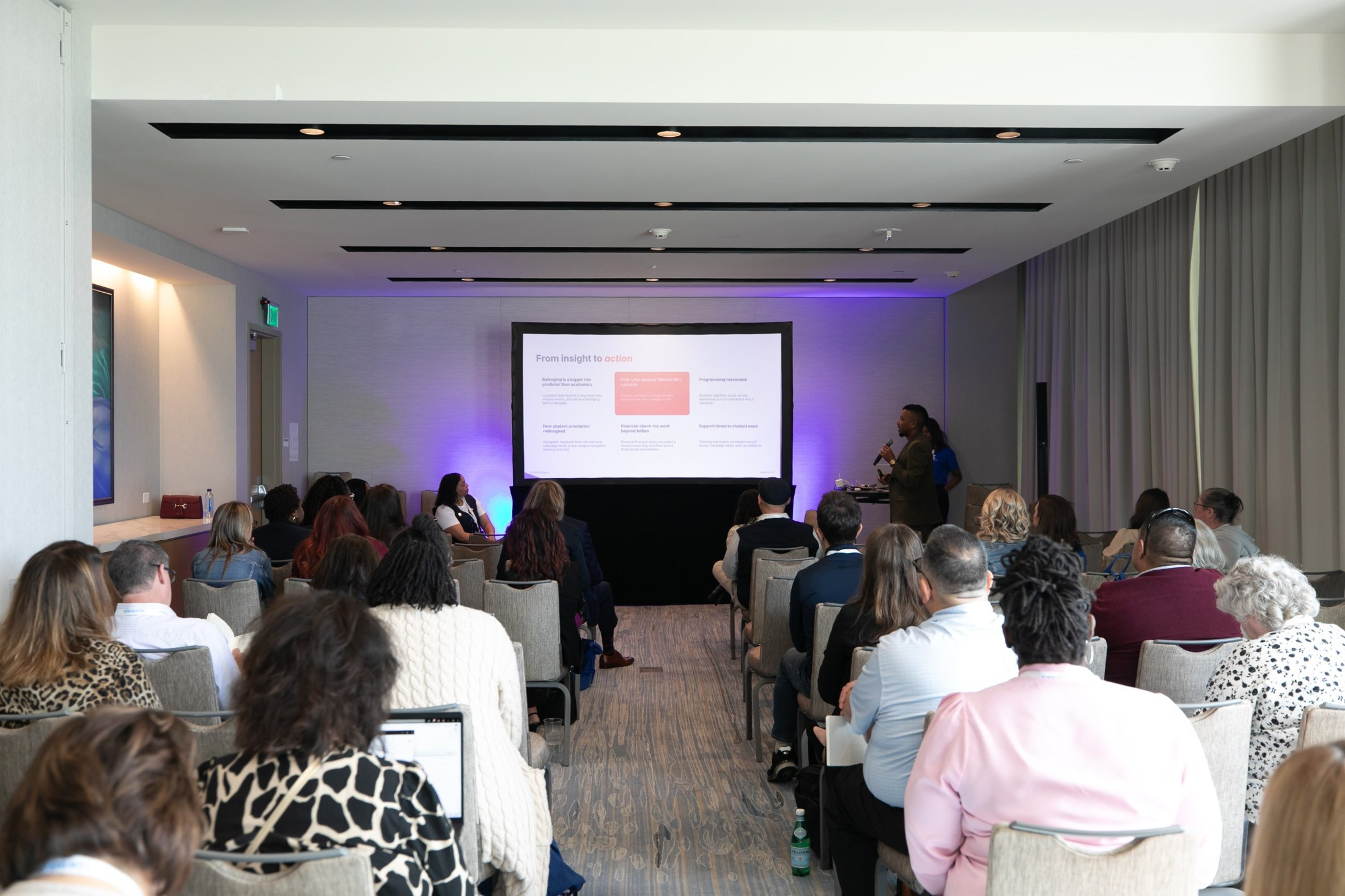
Student responses also directly shaped Dallas College programming:
- Belonging. Dallas College's own data backed a long-held view that belonging is a bigger risk predictor than academics. The finding shaped events and led to work on a belonging alert.
- First-year seminar. The seminar filled to 98% capacity, with custom messaging complementing additional staff outreach.
- Orientation. Feedback on campus navigation prompted a redesign of new student orientation.
- Financial check-ins. Personal financial stress, not just tuition, was shared as a large barrier, so financial aid and wellness teams now share ownership of a workflow to support those needs.
Teams formed around problems, not standing committees
Behind those results, Dallas College replaced committees that met all year with work teams built around a specific problem. Teams dissolve when priorities shift. Current teams cover the first-year experience and enrollment for adult learners, dual credit students, and re-enrollment. Each starts with impact planning: what are we trying to achieve, what are the inputs, what is the impact, and then the question the group asks last: "so what?"
Dallas College's leaders said this works because of relationships. Trust across divisions, built before the work starts, lets problem-based teams collaborate.
Buy-in came from communicating early and teaching the tools
Dallas College introduced this new focus on student voice before launch and kept people informed afterward:
- Leaders presented at a weekly Student Success Forum before launch.
- Staff learned the dashboard, including how to see alerts and intervention lists.
- Public updates to leaders and a biweekly newsletter kept results visible and thanked the people doing the work.
Leadership's advice for the group: be a user, not just an administrator. Learn the tool well enough to teach it, then tell your team, "I'm doing this too, and we'll figure it out together."
Dallas College now uses EdSights as the baseline for evaluating new technology, and it audits its knowledge base resources twice a year. Next, it plans to launch a belonging alert and begin a tiered caseload engagement strategy for its success coaches.
Want to hear how Dallas College did it? Join three of its leaders for a webinar on Tuesday, December 15, at 1:00 PM CT. Register here.
Curious how your campus could hear from students sooner and act on what they say? See how EdSights works.


See what EdSights can do for your team


